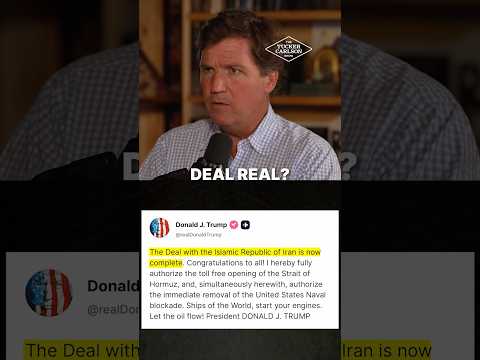
UPDATE: Trump’s Iran Peace Deal, Israel’s Move to Sabotage It and What to Expect Next
UPDATE: Trump’s Iran Peace Deal, Israel’s Move to Sabotage It and What to Expect Next
Přepis videa
Zobrazit / skrýt přepis
Thanks for doing this.
>> Thank you for having me.
Um, is this deal real?
>> I think so. I think this is a significant achievement, but nothing is fully real until they manage to get to the final agreement. And we already have a precedent in which we also see that when there was a final agreement, which there was in 2015 that Obama struck, it didn't mean that it necessarily would last because Trump walked out of that deal. So if this is something we want, we have to work at it. We have to work to keep it. These things are not part of the background that you can keep without putting any effort into it. And right now, we're not even halfway to the distance. But this is an important development.
>> So what are the key deal points as they're emerging to the extent we know now?
>> Yeah. First of all, we don't know enough because at the end of the day, there's been just so many different versions that have been floating around and some of them frankly do seem to be sabotage efforts. There's some of the hardline media in Iran that has been sending out these versions of the deal that I think deliberately were trying to raise people's expectations in order to make the final deal look bad. And they're doing it because they're trying to sabotage the pro-JCPOA faction in Iran. Super hardliners are dead set against it. In fact, there were protests that they organized, not huge ones in any way, shape, or form, particularly for a city of 10 million or plus in Tehran, but they were protesting outside of the Iranian foreign ministry and calling for the death of the foreign minister and the speaker of the parliament who've been negotiating this deal. So we should not for a second forget that there's a faction in Iran that is really against this.
But based on what it seems likely to have included, there's going to be an opening of the straits. It's going to take some time. You know, they have to do some demining, et cetera, to be able to fully make it safe. The US is going to lift its blockade, which I think ultimately complicated this matter much more so than helped the US. I think there will be some release of funds, but it will be done in a manner in which Trump can say that he never released the funds and the Iranians can say they got some of their money back. And it's going to be something that some of the GCC countries do in the middle to make sure that there's some money going to the Iranians while they're waiting for the actual Iranian money to be released.
And it's very important to keep this in mind. This is Iran's own money. They had about $120 to $150 billion in various banks around the world. That's how you do international trade. You have the money there and if you buy food or whatever from there, you use that money. These were frozen by US sanctions. So the Iranians could not access it.
>> For how long have they been frozen?
>> Well, they were frozen first under the Obama era until they struck a deal and then it was unfrozen. And then once Trump walked out of the deal in 2018, it was refrozen. So since 2018, almost six years, a lot of Iran's money has been in these banks and they've not been able to access it. Out of that $120 to $150 billion, the Iranian demand has been that for the JCPOA they should get roughly 8 to 10% released at the outset and another 12% released by the time that the JCPOA is concluded.
>> And this is their money, just to—
>> This is their money. So this is different. You know the story about how Obama released $1.7 billion when he signed JCPOA.
>> Yeah, he sent pallets of cash.
>> Pallet of cash, that is true. But that was very different. That was not frozen money. That was because there was a lawsuit between the United States and Iran since the beginning of the revolution. Because during the time of the Shah, we're talking about 1977, the Shah had ordered American weaponry. I don't remember if it was airplanes or tanks or whatever, but he was the biggest purchaser of American weaponry back in the 1970s. But between him paying for it and they're supposed to be delivered, the Iranians had a revolution. They took 52 American diplomats hostage. So the US clearly and understandably never delivered the weapons but also never returned the money.
So the Iranians took the US to court in the Hague International Court of Arbitration and the US was about to lose that fight. So the Obama administration chose to settle it as part of the JCPOA. It was only supposed to be $400 million but because of interest it added up to $1.7 billion. Here was the problem: how do you transfer the money to the Iranians when you have sanctioned every Iranian bank? Because of US sanctions, they actually had to put it on an airplane as cash and fly it to Switzerland where another plane was on the tarmac taking the money into that plane. Had there not been for the US sanctions, they could have just done a wire transfer.
>> But that was also Iranian money.
>> That was—well, it is Iranian money plus the interest because the US had kept it for so long. There's no deal in which the US will pay Iran any American money. There wasn't in the JCPOA and I don't believe that that will be the case with the Trump deal either.
>> So straits gets reopened. That takes, well, how long do you think if both sides decide they want it?
>> You know, it will be gradual but I think you will start seeing ships going through the straits in larger and larger numbers already from five days from now. But you have to remember there's a large number of ships that are stuck in the straits and they're not in great shape by now because they've been standing still in extremely warm water. So as soon as they get out of the straits and get to their home, wherever they're supposed to go, they have to go in for significant cleaning and that's going to create another problem when it comes to the flow of oil because there's just not going to be enough tankers on the seas.
Hmm. Straits open, some of Iran's cash gets unfrozen. What else in the deal?
And then of course after that the real stuff begins in terms of the negotiations over the nuclear issue. But one other thing that will happen before that is what the Iranians have insisted on and I think the administration correctly agreed to, which is that there has to be a regional ceasefire for this to be an end to the war. It cannot allow for other wars to continue in the region that can drag the US and Iran back into it. And this is where also the biggest weakness or vulnerability of this deal is because it means that the United States has to constrain Israel and the Iranians are going to have to constrain Hezbollah.
And we saw just hours before the announcement of the deal that the Israelis did everything they could to sabotage the deal by attacking southern Beirut, which they knew was a red line for the US and a red line for the Iranians.
What tell us about those attacks?
So there had been exchanges of fire between Hezbollah and Israel prior to that, but the Israelis were striking southern Lebanon.
The Hezbollah was striking both at Israel itself as well as Israeli forces inside Lebanon because the Israelis are inside Lebanon right now.
>> Yeah, they invaded it.
>> Yeah, they invaded it.
But it was not at a level that justified an escalation from the Israeli side to strike at Beirut itself, particularly after what happened about ten or so days ago in which they did strike Beirut knowing very well that there had been a warning both from Trump and by the Iranians.
And this time around, the Iranians did strike back at the Israelis, which is a very important development because for the first time, the Iranians were striking at Israel for Israel striking Lebanon, not because Israel had struck Tehran. This was an attempt by the Iranians to, after having established their own deterrence or reestablished their own deterrence, extend that deterrence to Lebanon.
They do so for a variety of reasons. One of them is, of course, that if the Israelis are allowed to just continue to bomb Lebanon and Gaza, etc., that war, that fighting will spill over into an Israeli-Iranian war at some point, and that will likely drag the US into it again. That's exactly what already has happened twice since October 7th.
So if you want to have a deal with the US and the US wants to have a deal with Iran that ends this war in a durable fashion, then you cannot allow the Israelis to continue to be able to restart that war.
So on the one hand, the Iranians wanted to establish that deterrence in order to make sure that the Israelis didn't do this. On the other hand, it is also a longer guarantee for the Iranians—what they call their forward defense, meaning that they want to have this presence or the support in Lebanon as a deterrent against the Israelis attacking Iran. Period. Because this is what they had before Assad fell, before Hezbollah was really weakened by the pager attacks.
Let me give you a quick story. In 2006, as you recall, you were there when Israel and Hezbollah went at each other. In the midst of that, I ran into Ephraim Sneh, at the time the deputy defense minister of Israel. I had interviewed him on several occasions before, and he told me very explicitly that Lebanon and Hezbollah is just a pit stop. The war with Iran is inevitable, but they have to essentially finish off Hezbollah first before they take the war to Iran.
But precisely because the Israelis never managed to defeat Hezbollah—in fact, the Israelis were defeated in that war—the war with Iran didn't start in 2006. This was a manifestation of the efficiency of Iran's forward defense. By being able to have Hezbollah there, they stopped the Israelis from taking the war to Iranian territory.
And the Iranians are now trying to reestablish that, which of course the Israelis are going to fight tooth and nail against, so that the Israelis will not be able to attack Iran again without knowing that they will have a very, very tough time with the Lebanese right on their own border.
You know what's really rare these days? A company that makes things in America—not just designed in America, conceived in America, assembled in America, but actually made in America start to finish in a factory with American workers. Brooklyn Bedding is that company.
Every mattress from Brooklyn Bedding is built in their Arizona factory. No middlemen, no cut corners to boost the margins. The founder started with nothing: no degree, no corporate backing. Just learned the craft, built a factory, created a product that is awesome. That's the American story that we support. We think you probably do, too.
At TCN, we love the Thermo Balance mattress collection. It's made a huge difference in the quality of sleep for a lot of people who work here. If you've ever woken at 2:00 a.m. sweating for no reason, well, you don't have to anymore. The cooling technology actually works and your back feels better in the morning. They're endorsed by the American Chiropractic Association, so it's real.
They also give you 120 nights to try out the product. If you don't like the mattress, they'll take it back or swap it out. No hassle. That's how confident they are in the products they make.
Visit brooklynbedding.com. Use the promo code Tucker at checkout for 30% off sitewide. This offer is not available anywhere else.
So why would Donald Trump—I mean, this does not sound like a win for the United States relative to where we were in mid-February. Explain the pressures on both Trump and the Iranians that got them to this point.
>> What's motivating Trump? What's motivating them?
>> Yeah, look. I think this war was a mistake from the outset, and I told the administration at the time this should not have been done.
>> The craziest thing any president...
>> And I specifically told them that you are misreading Iran. You think that the Iranians are much weaker than they are. I'm not saying that they were strong. In fact, I didn't think that they're going to be as successful as they frankly ended up being. But they were never as weak as the administration thought they were or as the Israelis were telling the administration.
But also, there was another major mistake, I think, in the administration's outlook on Iran. They thought that the Iranians feared war more than they feared capitulation and surrender. And Trump thought that by just taking one-third of the US Navy there, all of this mobilization, the Iranians would realize that war was real and as a result they would surrender. It was a complete misread.
The Iranians feared surrender far more than they feared war. They believed that they could survive war, perhaps even come out on top in that war, which I think they have in some ways. Surrender would be the end of the Islamic Republic. They would never surrender. Their system is incapable of surrendering. Their system.
>> Who would ever surrender? Who would ever prefer an unconditional surrender?
>> Well, from Trump's perspective, having just gone through Venezuela, he probably thought that the Iranians would be no different, but they were very, very different.
It's very important to understand right now the difficulty they have had in getting their system to agree to this deal. And as I mentioned, some of the ultra-hardliners are dead set against this. A surrender would require a full consensus, and there's no way they could ever get that in that system, particularly if you don't have a strong supreme leader that can actually push it through. And the new supreme leader is just weeks into his job and was not really necessarily expecting to get that job, particularly not in this manner.
So surrender was never in the cards.
Now try to make the case to them that this is going to lead to you if you think you're bluffing but they are going to fall fear of bluff you're gonna actually actualize this bluff and it's not going to work out the way you thought at all.
So I do think that obviously we're worse.
>> So you gave that advice I think you said that in public as well.
>> I did.
Yeah.
>> What kind of response did you get?
>> Very little. I mean, they were taking note, but nevertheless never got a real response. And it seemed to me, of course, I didn't have access to Trump himself, that his mind was set and that it was really difficult for anyone on the inside to be able to change his mind.
>> Yeah.
>> Why he had reached that position, I have less insight into, but I think over time that perception he had of Iranian weakness had been reconfirmed over and over again because the Iranians did not respond as harshly as they could have against the attack on Foro, for instance. I mean, the Pentagon called it a polite response. They gave a heads up. All of these different things.
>> Yeah. They took the Americans off the air base in Qatar. Yeah.
>> All of this just reinforced the idea that the Iranians don't have what it takes to actually face the United States. And I think it created this overconfidence.
There was another thing in my view as well that reinforced this in Trump's mind, and this is speculative on my end, but I do think there's some truth in it. The Iranians committed a huge mistake before this war, which is they never agreed to talk directly to Trump himself. And from their standpoint, they thought that by refusing this, which they did for a variety of reasons, but nevertheless, by refusing this, they showed strength. They showed that they're willing to say no to the superpower of the world.
But I think from Trump's perspective, it was the opposite, because Trump came in as president and said, "I'll talk to anyone. I'll talk to Kim Jong-un. I'll hang out with the former founder of al-Qaeda in Syria. You know, I'm capable of talking to everyone because I am strong, because I am stronger than all previous presidents."
>> Yeah. He had Tim Cook from Apple to the White House.
>> Exactly. But in the inverse of that, of course, is that if someone else is not talking to you and is unwilling to talk directly to you, that's not a sign of their strength. That's a sign of their weakness, because Trump again believes that talking to other people is a show of strength. So inadvertently, I think the Iranians actually reinforced Trump's own view of them as being weak by refusing to talk to him.
And obviously there's no guarantee that the war could have been avoided had they done so. But I think that if there was anyone who could have actually convinced Trump, "This is going to be a war. They're not going to capitulate. You might want to rethink this. And you might want to rethink the entire idea that you're going to get them to surrender at the negotiating table or anywhere else."
The only ones that ultimately could have done this would be the Iranians themselves. And they stood up that opportunity. They had plenty of opportunities. And I think that, again, it reinforced Trump's view that they're weak. And as a result, he thought that he could have this war over with.
>> Well, one of the problems is Iran is not a dictatorship. I mean, there's a very complex series of power-sharing agreements going on inside the country. Like, who runs the country? To outsiders, me anyway, I made a good faith effort to figure it out. I couldn't. It's deliberately opaque. That's on purpose.
>> Yeah, exactly. Back in the 2000s, the Iranians had a deliberate policy that they called "simulated irrationality," in which they wanted to—
>> Simulated irrationality.
>> It's essentially their version of madman theory, in which they, on the one hand, wanted to make sure that they were seen as somewhat irrational because if you're irrational, the other side has a greater difficulty calculating what your next move is. This is again what Nixon did, but they called it simulated irrationality. At the core of it, they're extremely calculating and extremely rational.
But there was also another problem. Their experience in the 1800s, particularly with the British interference in Iran, is that the British never really had to spend much money collecting intelligence in Iran. The Iranians were just volunteering it all the time. And it enabled the Brits to really manipulate the system and manipulate Iran. They didn't even have to colonize the country. They got exactly what they wanted from Iran without formally colonizing it.
A counter to that, a reaction to that, has been for them to try to create as opaque of a system as possible because that opacity makes it much more difficult for outside countries to be able to interfere, manipulate, or use factions within the Iranian system. But it's also a negative for them at the end of the day because the more opaque you are, the more untrustworthy you will be in the eyes of other countries. You can't really trust a country whose system you don't understand, whose processes you don't understand.
>> So whereas it may give them a degree of security in a very bad situation, in the long run it doesn't provide you with peace and security if everyone around you believes that you're untrustworthy because they don't understand your system.
So the Iranians at some point, hopefully, will transition away from that, but I don't think they will as long as this enmity between the United States and Iran is as intense, as existential, as it has been in the last couple years.
So again, what do you think drove both sides to this?
>> I think at the end of the day, both of them absolutely need this deal. Why I understand I think why Trump needs it—because the economy is going to fall apart if it's not resolved quickly. Why the Iranians need it? Look, the Iranians ultimately both need it because of sanctions relief. Their economy was in a terrible shape before this war. That's before $300 billion dollars of damage was inflicted on them as a result of this war. Beyond the loss of human life, you're also talking about infrastructure. Their steel industry, the petrochemical industry, have taken huge hits. So this is going to be very difficult for them. They need sanctions relief.
Look, the Israelis pushed the United States to sanction Iran already in the early 1990s because they saw Iran emerging as a rival to Israel in the region. Prior to that, they had actually had a long history of collaborating with the Iranians and having a tacit partnership and alliance. But if you want to destroy and weaken a country, you can do so by bombing them, which is what we saw here.
And you can also do so by having decades of sanctions on them that slowly but surely suffocate them, destroy their industries, etc.
And this is what we saw in Iraq. This is what we're seeing in Cuba right now.
So that type of a sanction, even though the Iranians have managed to resist it, even as the Russians currently are resisting a lot of these different sanctions, over time it destroys this fabric of society.
In Iraq, there was actually a study by the State Department, I think from 2004, as the US discovered how difficult it is to govern that country. And they did a study to try to better understand where the roots of the problems were. And one of the chapters dealt with the years of sanctions that had been imposed on Iraq.
And it pointed out that Iraq's economy under Saddam Hussein and the sanctions had shrunk to no more than 16 billion dollars total. And as a result, you had a situation in which the incentive structure for ordinary people to even send girls to schools was no longer there. What was the point of educating the children when there is no economy?
So you had a plummeting of literacy in Iraq, particularly amongst the female population.
So you tell me, how can you actually transition a country towards democracy when you have rising illiteracy? And this is Iraq, a country that historically has been the center of education and literacy in the Arab world. 50% of all books in Arabic used to be printed in Iraq. It's a long, long history that even precedes the arrival of Islam in Iraq.
So sanctions slowly but surely destroys these.
Why did the US, remind us, what were the pressures that pushed the US Congress to impose sanctions on Iraq? This is because of Saddam Hussein's attack on Kuwait and then later on the suspicions of his nuclear weapons program, right?
And so you had UN sanctions, you had the food for oil program. I was working at the UN at the time in the Security Council. Iraq was part of my portfolio. This is when I was working for the Swedish foreign ministry.
And I remember those meetings, you know, where I remember the Brits objected to toilet paper and lipstick as a dual-use technology. Dual use, could not send it into Iraq. I mean, it is the suffocation of a country.
And the Iranians need sanctions lifted. And from their standpoint, their best moment for the last couple of decades to actually have a real negotiation with the United States in which they do have leverage as a result of this mistaken war, to be able to get a deal that actually really lifts the sanctions, not the way it did in the JCPOA, but actually also takes away primary sanctions. They've never been in a better position to do so.
Now, they may not entirely see it that way. Certainly, some of the hardliners are opposed to it. They think the US is going to betray the deal, etc. But nevertheless, it is a strong position for them to have that negotiation.
So I certainly think that they should, and I think they also recognize that at the end of the day they cannot sustain this situation, the closure of the strait, etc., for a very long time without creating problems with other countries such as Russia and China and others who do matter to the Iranians.
Yeah. And all of Asia, I mean South Korea, and the world needs it open. Cost of living is already making it hard to live here, and it's not getting any better. Unfortunately, it's likely to get worse.
And a lot of Americans fill the gap with credit cards, not just for fancy dinners, but to cover things like groceries and bills. That is a disaster. It's understandable, but don't go down that road because there is a tax in effect, a survival tax of 20% interest or more.
Why would you do that? Why would you hand money to the big banks when you could keep it for your family?
Our friends at American Financing have a better way. If you're looking to buy your first home or refinance your current one, they're helping Americans achieve the dream of home ownership with monthly mortgage rates currently in the fives. American Financing saves its customers an average of 800 bucks per month. That's nearly 10 grand every year back to you.
This isn't just a loan. It's a total financial reset.
So, debt is tough, but there's a smart way to do it and a reckless, self-destructive way to do it: credit cards. And so we recommend American Financing. They're salary-based, not commission-based, which means they actually work for you, not the banks. They're called America's Home for Home Loans for a reason.
Call 800-685-5696 or visit americanfinancing.net/ducker.
So what are the chances this actually works and what could derail it?
The biggest risk of derailment, of course, is from the Israelis. I mean, Netanyahu has been pushing the United States to go to war with Iran for more than 25 years. He finally got his wish, but it just didn't end up the way he thought it would. But he's not going to give up.
And there's plenty of opportunities for the Israelis to derail this, particularly by restarting a war with Lebanon. You know, at the end of the day, you just need a couple of successful attacks and the whole thing can fall apart.
So, if Trump wants to keep this, and I hope he does, and I do think that he's serious, because as you pointed out, he needs to get out of this as well, it is not sufficient to just have an angry phone call with Netanyahu every once in a while, or to do so in reaction to Netanyahu actually violating some of the US's red lines.
There needs to be consistent pressure on the Israelis to make sure that they don't do this. And I would go one step further.
Part of the reason why the Israelis would do this is because they believe that if they restart the war, the US has no choice but to re-enter the war on Israel's side. If the United States makes it very clear to the Israelis that that equation is over, if the Israelis start a war against not only a deal that Trump has struck, but what I think he hopes becomes part of his legacy, then the US is out and the Israelis are going to have to deal with the Iranians on their own, which I don't think they can do.
Without all of the support of the US, particularly the defensive support in terms of shooting down Iranian missiles that are heading towards Israel, the Israelis cannot tolerate a war with Iran for very long.
So if they know that they cannot drag the US in, their incentives for sabotaging the deal will also diminish, because the outcome that they're looking for is no longer secured in any way, shape, or form.
So I think Trump has that ability and I think proactively he should make it very clear: If Israel restarts another war with Iran, regardless of how it starts, the US is out.
What do you think the chances are of the United States allowing Israel to lose a war against Iran?
I'm just going to say zero. All depends.
I mean, I think you're absolutely right.
We've seen it so far that the US, you know, there will be a tremendous amount of pressure domestically to support it.
But I think also things are changing.
I mean, right now the standing of Israel has plummeted amongst the American public in almost every demographic except for boomer Republicans. That want genocide, it hurts your reputation.
It does. Well, who would have thought, right?
Zobrazena první část přepisu (27 770 z 103 790 znaků).